Insta360 vs GoPro: Which Action Camera Should You Buy?
A buyer's guide to choosing between Insta360's flexible 360 and flat action cameras and GoPro's traditional rugged flat-lens action cams.
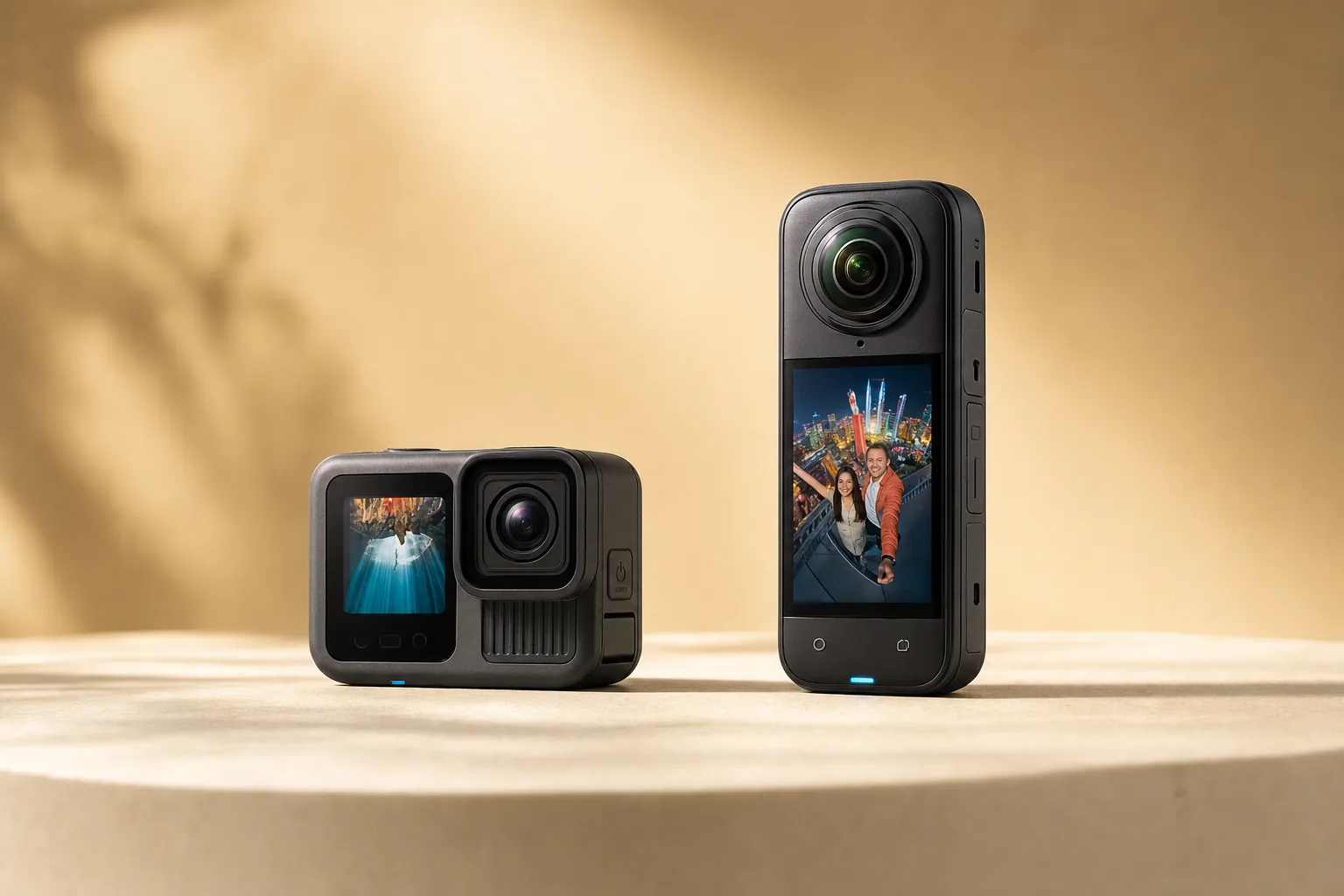
The short answer to insta360 vs gopro is that it depends on how you want to shoot: the Insta360 X5 is a 360 camera that captures everything around it so you can reframe later, the Insta360 Ace Pro 2 is the closest flat-camera rival to GoPro, and the GoPro Hero 13 Black is the established flat action cam with the deepest mounting and lens ecosystem. All three are excellent, but they solve different problems.
Because one of these (the X5) isn’t a traditional point-and-shoot action cam at all, the most useful way to read this comparison is in two layers: the X5 as the 360 option, and the Ace Pro 2 vs Hero 13 as the head-to-head flat-cam fight.
GoPro vs Insta360 in three sentences
If you want one flat action camera and the biggest choice of mounts, lenses and accessories, buy the GoPro Hero 13 Black. If you want higher resolution, better low light and a flip screen in a flat camera, buy the Insta360 Ace Pro 2. If you would rather capture everything and frame the shot afterward, buy the Insta360 X5, which is a 360 camera and a different tool. The rest of this page is the evidence for those three sentences.
Insta360 vs GoPro at a glance
| Spec | Insta360 X5 | Insta360 Ace Pro 2 | GoPro Hero 13 Black |
|---|---|---|---|
| Capture type | 360 (dual-lens) | Flat / single-lens | Flat / single-lens |
| Sensor | Dual 1/1.28” | 1/1.3” (Leica Summarit lens) | 1/1.9” |
| Max video | 8K30 (360, 7680×3840); 4K60 single-lens | 8K30; 4K120 | 5.3K60; 4K120; 2.7K240 |
| Max photo | 72MP (360); 36MP single-lens | 50MP | 27MP |
| Stabilization | FlowState + 360° Horizon Lock | FlowState + Horizon Lock | HyperSmooth 6.0 |
| Waterproof | 15m (49ft); 60m with dive case | 12m (39ft) | 10m (33ft) |
| Battery | 2400mAh, up to ~185 min | 1800mAh, up to ~180 min | 1900mAh Enduro, up to ~2.5 hr |
| Weight | ~200g | ~182g | ~157g |
| Screen | 2.5” touchscreen | 2.5” flip touchscreen | Front + rear touchscreen |
| Interchangeable lenses | Replaceable lens covers | No | HB-series lens mods |
| Approx. price | Around $550 | Around $400-450 | Around $319-450 |
What sets each apart
The Insta360 X5 is the odd one out in the best possible way. Its two 1/1.28” sensors fire at once and stitch into a full 360 sphere, so you don’t aim the camera the way you do a GoPro: you capture everything, then choose your shot afterward in the app. That reframe workflow is the whole point. You can keep yourself in frame on a mountain-bike run, swing a virtual camera around a moment, or pull a stable flat 1080p/4K clip out of the sphere after the fact. It shoots up to 8K30 in 360 and 72MP 360 stills, with FlowState stabilization and 360° Horizon Lock that keeps footage level no matter how the camera tumbles. It’s waterproof to 15m on its own (60m with the Invisible Dive Case), and the replaceable lens covers are a genuinely useful repair option since the bulging lenses are the part most likely to get scratched. The trade-off: 360 footage takes editing time, and single-lens mode tops out lower (4K60), so it’s a creative tool more than a grab-and-go cam.
The Insta360 Ace Pro 2 is the direct GoPro flat-cam rival, and it’s the one to weigh against the Hero 13 spec-for-spec. It pairs a large 1/1.3” 8K sensor with a Leica Summarit lens and goes up to 8K30 video and 50MP photos, with 4K120 for slow motion. A dual-chip design (a dedicated imaging chip plus a 5nm AI chip) drives its low-light processing and noise reduction, which is where it tends to pull ahead. The flip-up 2.5” front screen makes it strong for vlogging and selfie framing, and it’s waterproof to 12m out of the box. If you want the highest flat-camera resolution and the best low-light story, this is the pick.
The GoPro Hero 13 Black counters with maturity rather than raw resolution. Its 1/1.9” sensor tops out at 5.3K60 (plus 4K120 and a wild 2.7K240 for slow motion) and 27MP photos, with the dependable HyperSmooth 6.0 stabilization that built GoPro’s reputation. The real ecosystem advantage is twofold: the largest universe of mounts, housings, and accessories in action cameras, and the new HB-series interchangeable lens mods (macro, ultra-wide, anamorphic, ND filters) that auto-detect when attached. Its 1900mAh Enduro battery is rated up to about 2.5 hours of continuous recording, and at ~157g it’s the lightest of the three. If you already own GoPro mounts or want the safest, most-supported flat cam, the Hero 13 is the comfortable choice.
Who should buy which
- Buy the Insta360 X5 if you want to capture everything and reframe later, shoot immersive or 360 content, or never miss a moment because you didn’t aim in time, and you don’t mind editing.
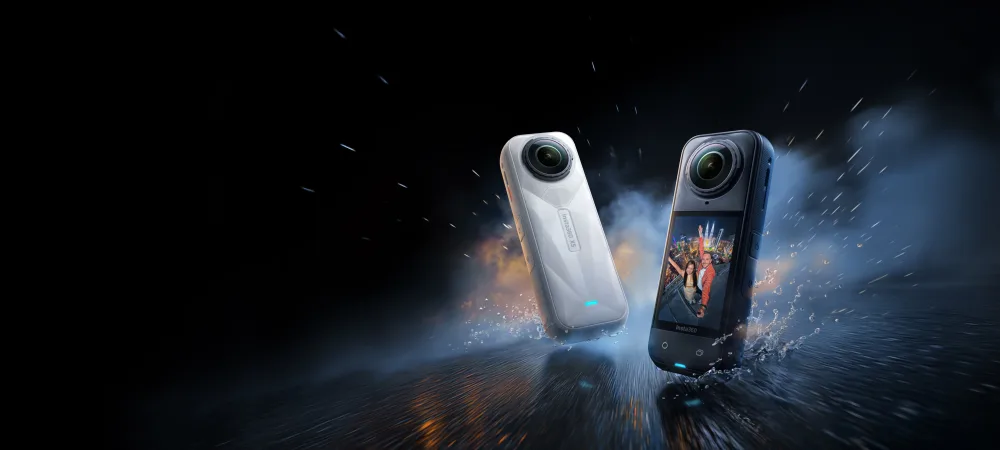 Insta360 · Compact sensor · ActionInsta360 X5from $550See price comparison →
- Buy the Insta360 Ace Pro 2 if you want a flat action cam with the highest resolution (8K30), the best low-light performance, 50MP photos, and a flip screen for vlogging.
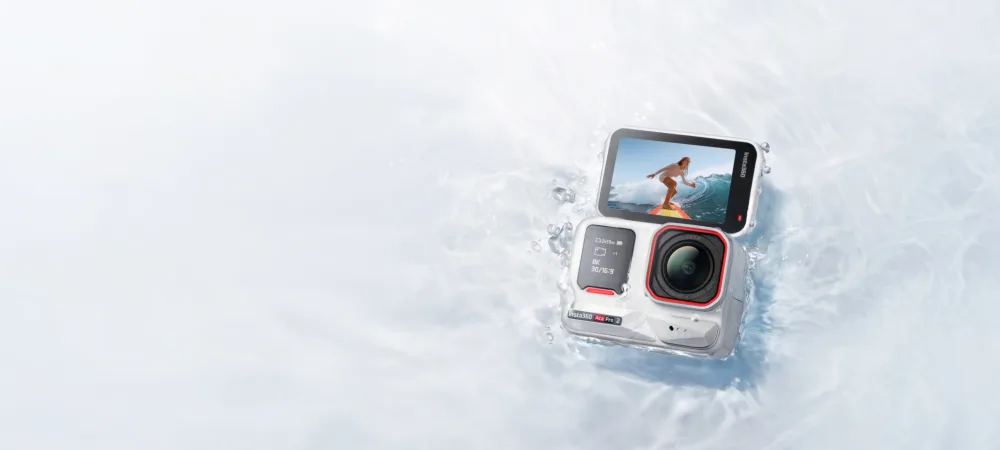 Insta360 · Compact sensor · ActionInsta360 Ace Pro 2$390See price comparison →
- Buy the GoPro Hero 13 Black if you value the deepest accessory and mount ecosystem, HyperSmooth reliability, interchangeable HB-series lenses, the lightest body, and the longest continuous battery life.
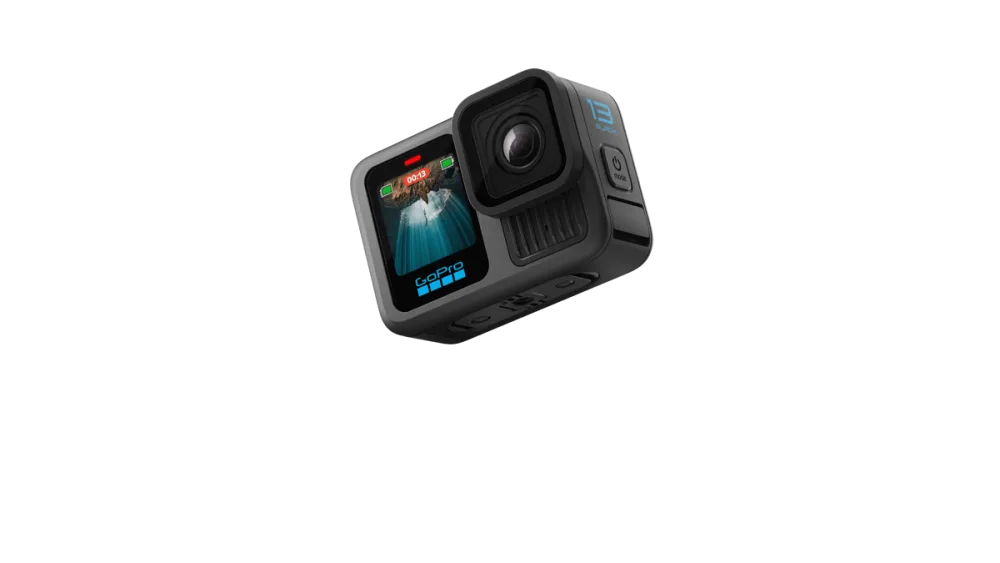 GoPro · Compact sensor · ActionGoPro Hero 13 Blackfrom $330See price comparison →
Bottom line
If you’re choosing between formats, the X5 is in a different category: it’s the 360 reframe camera, best for creators who want flexibility in the edit. Between the two flat cams, the Ace Pro 2 wins on resolution (8K30), photo detail (50MP), and low light, while the Hero 13 Black wins on ecosystem, lens accessories, weight, and battery runtime. None of these is a bad camera, so let your shooting style and existing gear decide. Prices move often across retailers, so check the live comparison above before you buy.
Find the camera worth buying
We compare live listed prices and link you straight to the lowest one. No fake discounts.